原文:Small Fire · Python 基础 · Python 子专栏 · Small Fire 技术笔记
变量定义和数据类型
变量定义
Python的变量命名规则:
硬性规则:
- 变量由字母、数字和下划线构成,不能以数字开头
- 大小写敏感
- 不能跟python的关键字和系统保留字冲突
PEP8要求:
- 用小写字母拼写,多个单词用下划线连接
- 受保护的实例属性用单个下划线开头
- 私有实例属性用两个下划线开头
Python关键字列表:
| False | class | finally | is | return |
|---|---|---|---|---|
| None | continue | for | lambda | try |
| True | def | from | nonlocal | while |
| and | del | global | not | with |
| as | if/else/elif | or | yield | assert |
| import | break | pass | except | raise |
| in | _ __ ** | ***** |
数据类型
基本数据类型:
- 整型:对整数的处理
- 浮点型:对小数的处理
- 字符串型:单引号和双引号引起来的任意文本
- 布尔型:True和False两种值,也可通过计算得出
- 复数型:数学表示法
7i+8j int():将一个数值或字符串转换成整数,可以指定进制。float():将一个字符串转换成浮点数。str():将指定的对象转换成字符串形式,可以指定编码。chr():将整数转换成该编码对应的字符串(一个字符)。ord():将字符串(一个字符)转换成对应的编码(整数)。
复杂数据类型:
- 列表: ,可以存储任意类型,任意数量的变量
- 集合:{ },可以存储任意类型变量,定以后不能更改其元素
- 字典:{},以键值对形式存储数据元素
运算操作符
| + | 和 | / | 除 | « | 左移 | & | 按位与 | <= | … | is/is not | 身份运算符 |
|---|---|---|---|---|---|---|---|---|---|---|---|
| - | 差 | // | 模 | » | 右移 | | | 按位或 | >= | … | in/not in | 成员运算符 |
| ***** | 积 | % | 整除 | < | 小于 | ^ | 按位异或 | == | … | not/and/or | 逻辑运算符 |
| ****** | 幂运算 | @ | > | 大于 | ~ | 按位取反 | != | … |
在实际开发中,运算会有不同的优先级,可以用括号保证运算的执行顺序。
Delimiters
| ( ) | , | : | - > | *= | %= | |= | «= |
|---|---|---|---|---|---|---|---|
| [ ] | . | ; | += | /= | @= | ^= | **= |
| { } | @ | = | -= | //= | &= | »= |
分支结构
在Python中,构造分支结构使用if、else和elif关键字。与其他语言不同Python没有使用花括号构建代码块,而是使用其独特的缩进方式来设置代码的层次结构。连续的代码保持相同的缩进那么就属于同一个代码块。
分支结构是可以嵌套使用的。
List
list.append(x)
list.extend(iterable)
list.insert(i,x)
list.remove(x)
list.pop([i])
from collections import deque  :  deque([])   deque.popleft()
list.clear()   =  del list
list.index(x[,start[,end]])
list.count(x)
list.sort(key = None,reverse=False)
list.reverse()
list.copy() = a[:]
Tuples & Sequences
1. enumerate():
   for i, v in enumerate(['tic', 'tac', 'toe']):
	...     print(i, v)
	...
	0 tic
	1 tac
	2 toe
2. zip()  reversed()  sorted()
3.
JSON
python 与 JSON对照:
dict              {}
list              []
str               'string'
int/float         1234.56
True/False        true/false
None              null
>import json
>json.dumps([1, 'simple', 'list'])
>'[1, "simple", "list"]'

pickle : Pickle Module
	    pickle.dump().
	    pickle.load()
函数(FUN)
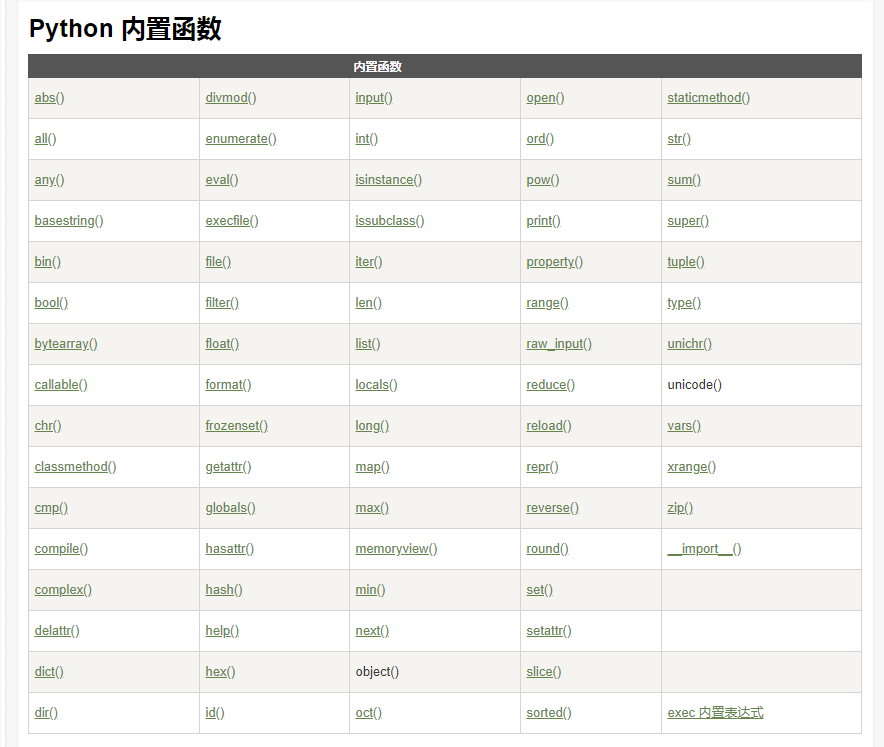
位置参数:
		 根据参数位置匹配
默认参数:def fun(arg1,arg2,arg = 'xxx')
		 1.定义默认参数时,,默认参数必须指向不变对象
		 2.当函数有多个参数时,将变化大的参数放前面,变化小的放后面。变化小的可以作为默认参数。
	     3. 默认按参数位置匹配,可以通过名字进行相应的默认字段赋值
可变参数:def  fun(arg1,arg2,*numbers)
		 允许传入多个参数,在函数调用时自动组装成一个tuple
		 当参数为list或则tuple时,可以使用*list,*tuple
关键字参数:def fun(arg1,arg2,**kw)
		 允许传入多个含参数名的参数,这些关键字参数在函数内部自动组装为一个dict。
		 传入dict时,只是将所有的参数传入函数,对参数的改变不会影响到函数外的dict
命名关键字参数:def fun (arg1,arg2,*,arg3,arg4)
		 对于关键字参数,需要在函数内部进行检查,使用命名关键字必须传入参数名
参数组合:
		参数定义的顺序(必选参数,默认参数,可变参数,命名关键字,关键字参数)
对于任意函数,都可以通过类似func(*args, **kw)的形式调用它,无论它的参数是如何定义的。
递归函数
注意栈溢出问题
解决递归调用栈溢出的方法是通过尾递归优化,事实上尾递归和循环的效果是一样的,所以,把循环看成是一种特殊的尾递归函数也是可以的。
尾递归是指
在函数返回的时候,调用自身本身,并且,return语句不能包含表达式。这样,编译器或者解释器就可以把尾递归做优化,使递归本身无论调用多少次,都只占用一个栈帧,不会出现栈溢出的情况。
迭代器(Iterable)
1. 原理:
  For调用了var = iter(str),next(var),当next()没有元素时,raise a StopIteration
2. 集合数据类型:list、tuple、dict、set、str等
  generator:sum(i*i for i in range(10))
  包括生成器和带yield的generator
    function def reverse(data):
      for index in range(len(data)-1, -1, -1):
        yield data[index]
模块(Mod)
导入整个模块:import modname.   from modname import *.
导入模块部分:from modname import name1[, name2[, ... nameN]].
OS Interface:
  os:getcwd()  chdir()  system() open()
  shutil:copyfile('source','aim')     move('source','aim')
File Wildcards:
  glob:glob.glog('*.py')
Output Formatting:
  reprlib: reprlib.repr(set('adfasfsadfsfsfsfs'))
  pprint: pprint.pprint((source,width = vaule))
  textwrap:格式化输出段落适应屏幕宽度  textwrap.fill(source,width=value)
  locale:culture specific data formats
      x = 1234567.8
      locale.format_string("%s%.*f", (conv['currency_symbol'],conv['frac_digits'], x), grouping=True)
      '$1,234,567.80'
Command Line Arg:
  sys: sys. args  sys.stdin sys.stdout, sys.stderr.write('Error msg') , sys.exit()
  getopt:
  argparse:
String Pattern Matching:
  re:re.fundall(), re.sub  etc.
Templating:
  string(Template):t = Template('${village}folk send $$10 to $cause.')
      t.substitute(village='Nottingham', cause='the ditch fund')
      >>>'Nottinghamfolk send $10 to the ditch fund.'
Mathematics:
  math:math.cos(),math.log() etc.
  random:random.choice([]),random.sample(range(100),10) etc,
  statistics:(mean,median,variance)etc.
Internet Access:
  urllim.request(retrieving data from URLs):
  smtplib(sending mail): server = smtplib.SMTP('xxx')
  server.sendmail('from_email','to_email')
  server.quit()
Dates and Times:
  datetime(date) :  date.today()
Data Compression: (zlib,gzip,bz2,lzma,zipfile,tarfile)
  zlib:zlib.compress('source')   zlib.decompress('zlib_source')
Quality Control:
  doctest: doctest.testmod()
  unittest: unittest.TestCase   assertRaises():   unittest.amin()
Multi-threading:;
  threading: threading.Thread
Logging:
  logging: sys.stderr(file)   logging.debug()
  logging.info()  logging.warning()  logging.error() logging.critical()
Weak References:
  wearkref:
Tools For Lists:
  array: a = array('H',[1213,1414,4124])   sum(a)-只计算list中的内容,对a的操作只对list有效
  collections(deque):
  bisect:manipulation sorder lists  bisect.insort(aim,source)
  heapq:use for repeatedly access the smallest element do not run a full list sort(堆排序)
    heapify(list)   heappush(list,value)   [headppop(list) for i in range(x)]
Decimal Floating Point Ath:(精准计算)
  decimal:
    help for 1> financial applications and other uses which require exact decimal representation
             2> control over precision
             3> control over rounding to meet legal or regulatory requirements
             4>	tracking of significant decimal places, or
             5> applications where the user expects the results to match calculations done by hand
包管理(pip)
Virtual environments:
1. Create
	On Windows, invoke the venv command as follows:
		python -m venv c:\path\to\myenv
		venv [-h] [--system-site-packages] [--symlinks | --copies] [--clear]
      			  [--upgrade] [--without-pip]
       			  ENV_DIR [ENV_DIR ...]
2. Activate
	安装名\Scripts\activate.bat
3. Managing Packages  pip(On Virtual)
	https://pypi.org/
	pip search xxxx.(查找)
	pip install xxxx.(安装)
	pip install xxxx=version.(安装指定版本)
	pip install --upgrade xxxx.(更新到最新版本)
	pip show xxxxx.(显示包有关信息)
	pip list:(将显示虚拟环境中安装的所有软件包)
	pip uninstall xxx,xxxx,xxxx.(卸载)
	pip freeze > requirements.txt.(以指定文件格式显示已安装软件包)
异常(Error)
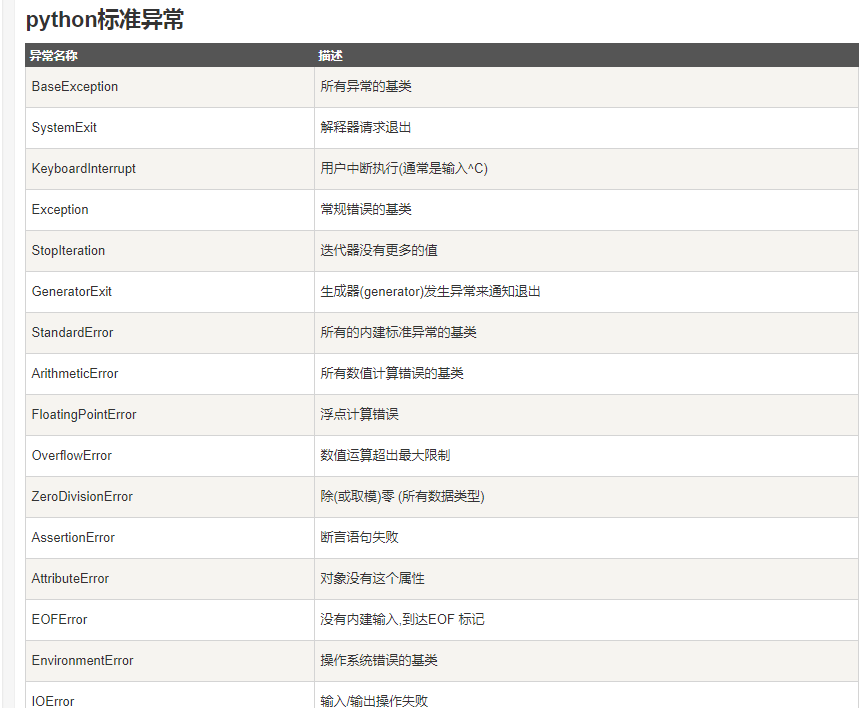
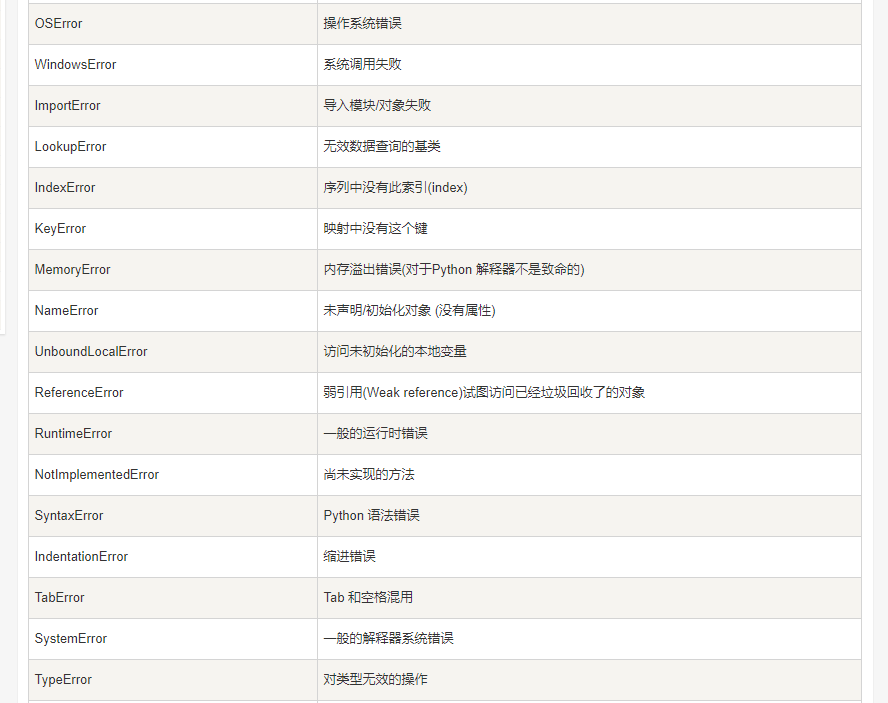
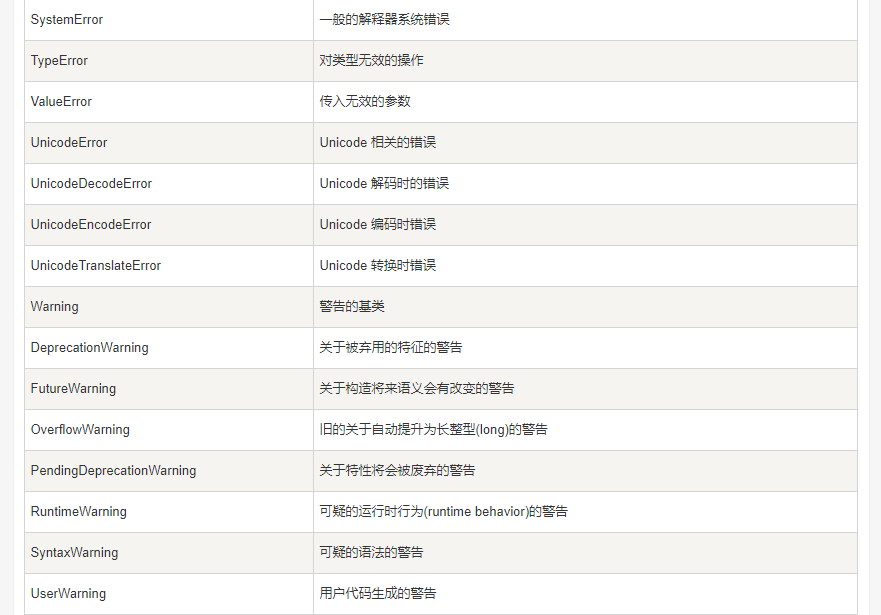
1. 捕捉异常:
	try:
	<语句>        #运行别的代码
	except <名字>:
	<语句>        #如果在try部份引发了'name'异常
	except <name1,name2>,<数据>:
	<语句>        #如果引发了'name'异常,获得附加的数据
	else:
	<语句>        #如果没有异常发生
2. 最终处理
	try:

	finaly:

	raise:
3. 自定义异常
	class Error(Exception):
	    """Base class for exceptions in this module."""
	    pass
	class InputError(Error):
	    """Exception raised for errors in the input.
	    Attributes:
	        expression -- input expression in which the error occurred
	        message -- explanation of the error
	    """
	    def __init__(self, expression, message):
	        self.expression = expression
	        self.message = message
	class TransitionError(Error):
	    """Raised when an operation attempts a state transition that's not
	    allowed.
	    Attributes:
	        previous -- state at beginning of transition
	        next -- attempted new state
	        message -- explanation of why the specific transition is not allowed
	    """
	    def __init__(self, previous, next, message):
	        self.previous = previous
	        self.next = next
	        self.message = message
面向对象(OO)
1. 定义
	类帮助信息:ClassName._doc_查看
	class_suite:有数据属性,类成员,方法组成
	self:代表类的实例,当前对象的地址,而非类,self.class则指向类
	class ClassName:
	   """所有员工的基类"""  #类文档字符串
	   empCount = 0    #数据属性
	   def __init__(self, name, salary):   #该方法接收参数
	      self.name = name
	      self.salary = salary
	      Employee.empCount += 1
	   def displayCount(self):
	     print "Total Employee %d" % Employee.empCount
	   def displayEmployee(self):
	      print "Name : ", self.name,  ", Salary: ", self.salary
2. 添加,删除,修改,访问类的属性
	demo.attr = value1:添加属性
	demo.attr = value2:修改属性
	del demo.attr:删除属性
	getattr(obj,name[,default]):访问对象的属性
	hasattr(obj,name[,default]):检查是否存在一个属性
	setattr(obj,name[,default]):设置一个属性。如果不存在,会创建一个新属性
	delattr(obj,name):删除属性
3. 内置属性类
	__dict__:类的属性(包含一个字典,由类的数据属性组成)
	__doc__:类的文档字符串
	__name__:类名
	_module_:类定义所在的模块
	_bases_:类的所有父类构成元素
	__del__:析构函数,在队象销毁时被调用
	__class__:是实例的类
4. 对象销毁(垃圾回收)
	采用引用计数来跟踪和回收垃圾
5. 封装
	如果类具有__setattr__()或 __delattr__()方法,则调用此方法而不是直接更新实例字典。
	__getattr__(self,attr1,attr2):
		setattr(self,attr1,attr2)
	object.__getattriabute__()
	get(self,实例,所有者)  set()  delete()  set_name()
	slots():为此变量分配字符串,可迭代,阻止每个实例自动创建__dict__和__weakref__
6. 类的继承
	(1) 语法:class 派生类名(basic1,basic2):...
	      调用:__init_subclass__
	(2)Python内置的@property装饰器就是负责把一个方法变成属性调用
	(3)mixln:主线都是单一继承下来的,例如,Ostrich继承自Bird。但是,如果需要“混入”额外的功能,
             通过多重继承就可以实现,比如,让Ostrich除了继承自Bird外,再同时继承Runnable
7. 元类
	class OrderedClass(type):
	    @classmethod
	    def __prepare__(metacls, name, bases, **kwds):
	        return collections.OrderedDict()
	    def __new__(cls, name, bases, namespace, **kwds):
	        result = type.__new__(cls, name, bases, dict(namespace))
	        result.members = tuple(namespace)
	        return result
	class A(metaclass=OrderedClass):
	    def one(self): pass
	    def two(self): pass
	    def three(self): pass
	    def four(self): pass
	>>> A.members
	('__module__', 'one', 'two', 'three', 'four')
正则表达式
1. 匹配
	 \d:匹配一个数字
	 \w:匹配一个字母或数字
	 \s:匹配一个空格(TAB)
	 .:可以匹配任何字符
	 *:表示任意个字符(包括0个)
	 +:表示至少一个字符
	 ?:表示0个或1个字符
	 {n}:表示n个字符
	 {n,m}:表示n-m个字符
	 A|B:可以匹配A或B
	 ^:表示行的开头,^\d表示必须以数字开头。
	 $表示行的结束,\d$表示必须以数字结束。
	 [0-9a-zA-Z\_]:可以匹配一个数字、字母或者下划线
	 [0-9a-zA-Z\_]+:可以匹配至少由一个数字、字母或者下划线组成的字符串,比如'a100','0_Z','Py3000'等等
	 [a-zA-Z\_][0-9a-zA-Z\_]*:可以匹配由字母或下划线开头,后接任意个由一个数字、字母或者下划线组成的字符串
	 [a-zA-Z\_][0-9a-zA-Z\_]{0, 19}:更精确地限制了变量的长度是1-20个字符(前面1个字符+后面最多19个字符)
2. match()方法判断是否匹配,如果匹配成功,返回一个Match对象,否则返回None
	print(re.match(r'^\d{3}\-\d{3,8}$', '010-12345'))
	re.match(r'^\d{3}\-\d{3,8}$','010 12345')
3. 切割 re.split()
	st = re.split(r'[\s\,\;]+', 'a,;;b, c  d')
	print(st)
4. 分组 如果正则表达式中定义了组,就可以在Match对象上用group()方法提取出子串来 0:原始,1:第几个字串
	m = re.match(r'^(\d{3})-(\d{3,8})$','010-12314')
	print(m)
	print(m.group(0))
	print(m.group(1))
	print(m.group(2))
5. 贪婪匹配:正则匹配默认是贪婪匹配,也就是匹配尽可能多的字符.
	print(re.match(r'^(\d+)(0*)$', '102300').groups())
 	加个?就可以让\d+采用非贪婪匹配
	print(re.match(r'^(\d+?)(0*)$', '102300').groups())
 6. 编译:
 	编译正则表达式,如果正则表达式的字符串本身不合法,会报错;
 	用编译后的正则表达式去匹配字符串。